Skip to content
See packages

RoboticsRobotics integration: build and test one working system before rollout.

We study the task and its environment, choose sensors, actuators and controllers, and build a working pilot. We test it on site before rollout.

Packages

Start with a package

Four packages, each with its price on the page. Pick one and buy it online.

Billing

What you get

What you walk away with.

  1. Feasibility study: the task, its cost, the build
  2. Bill of materials with reasons and rejected alternatives
  3. One working version on site, measured
  4. Operator screens, procedures and system integration
  5. Documentation, spares list and update process
  6. Calibration record for each sensor

Sounds like

You might recognize one of these.

  • We are paying people to do the same lift, pick or scan hundreds of times a shift.

  • We want to know what is happening in the building without sending someone to look.

  • We have an idea for a product with a sensor in it and nobody to build the first one.

  • The pilot worked. Now we need forty of them and nobody knows how.

The work

A project like this one.

All case studies
  1. Hardware & Instrumentation

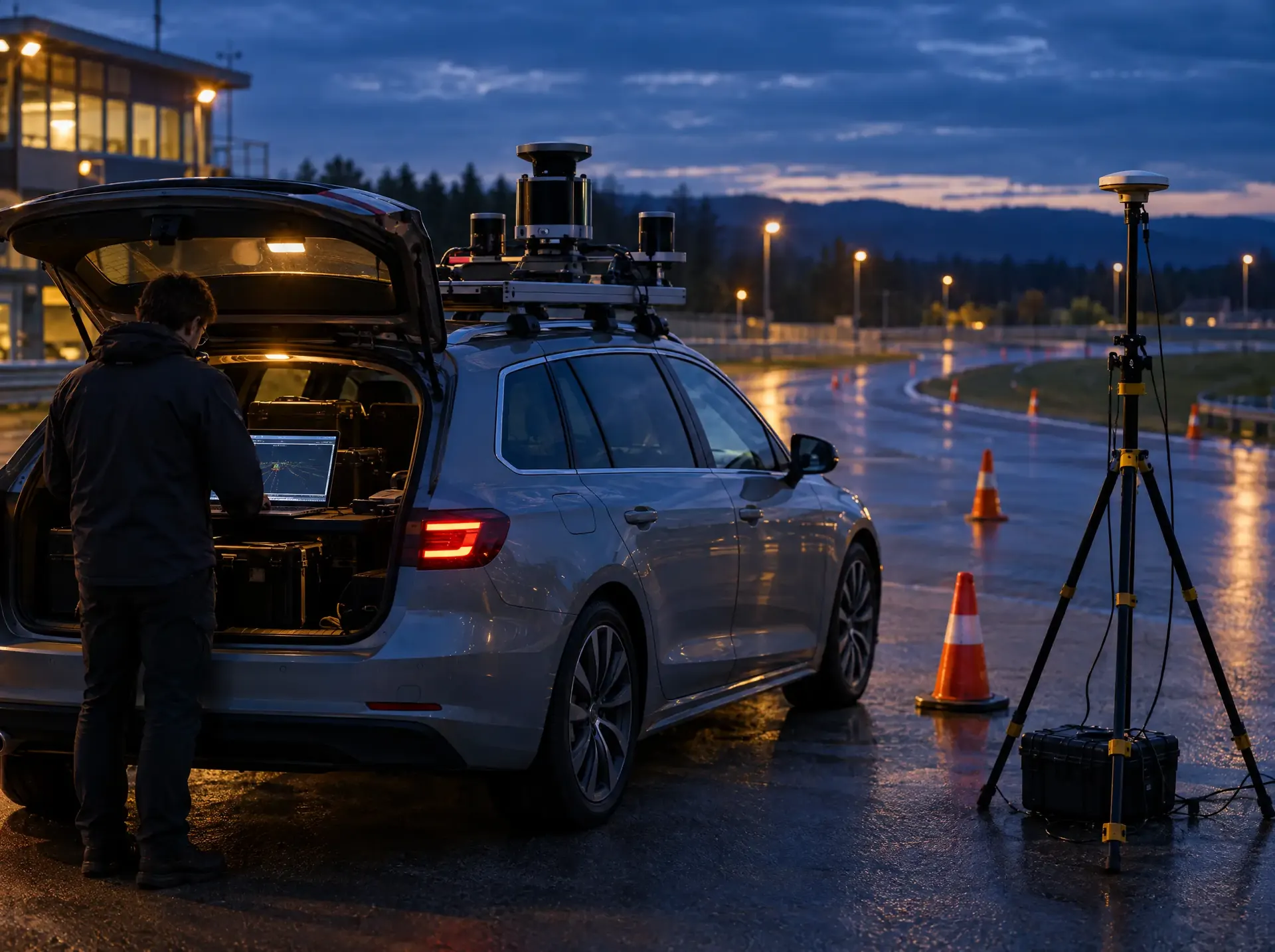
    Tracking self-driving test vehicles

    A university-affiliated autonomous vehicle test range2024–present

    Read the case study
    Position and rotation, comparable across runs
    One frame
    Never decommissioned
    Still running

How it runs

Phases and timing.

  1. 1–4 weeks

    Feasibility and automation plan

    What the task is, what it costs today, what building for it would take and whether the answer justifies the build. This phase can end in a recommendation to build less than was asked for.

  2. 4–6 weeks

    Pilot build

    One working version built end to end and running on site: the sensors, actuators, controllers, integration and operator screens, measured against what it was built to do.

  3. Ongoing

    Rollout

    The remaining units, with updates, spares and fault handling run as a process rather than as a series of favors.

The detail

What the scope includes.

Robotics

We design custom hardware that automates a physical action. We study the task and the space first, then build one working version and prove it on site before anything is rolled out.

More about Robotics

Each design brings together three kinds of instrumentation:

Sensors
Measuring what is happening in a space, on a machine or in a process
Actuators
The motors, valves and grippers that carry out the action
Controllers and processing
The logic that reads the sensors and decides what the actuators do

We choose proven parts wherever they fit and connect the result to the systems you already run. We specify, integrate and program hardware; we do not manufacture it.

When this service fits

  • You want to automate a physical action
  • You want to collect data about your environment
  • You want to deploy physical monitoring systems
  • You want an interactive system your customers use in person
  • You want to create a custom smart product
Show all 6 parts of the scope
  • Task and feasibility study

    The task, how often it happens, what it costs today and what a build would take. Sometimes the answer is no new hardware.

  • Sensors

    Each sensor is placed and calibrated so a reading means what it says. A calibrated sensor in the wrong position gives confidently wrong data forever.

  • Actuators

    Motors, valves and grippers chosen from proven parts. When nothing off the shelf works, we design the part and hand the production package to a contract manufacturer; we do not manufacture.

  • Controllers and integration

    Logic on a controller or edge processor sized for the job, connected to your equipment (Modbus, OPC UA, serial) and your software. What happens when the network drops is designed in.

  • Operator screens

    Interfaces for the person running the hardware: start it, stop it, clear a fault and see why it stopped, in as few steps as possible.

  • Safety and handover

    Guarding, stops and a written risk assessment before anything that moves runs near people, plus the documentation, spares and update process to keep it running.

Show the tools we use
Sensing
  • Machine vision
  • Load cells
  • Current transformers
  • Thermocouples and RTDs
Actuation
  • Motors and motor control
  • Valves
  • Grippers and end effectors
  • Linear actuators
Control and integration
  • Microcontrollers
  • Linux on ARM
  • Modbus TCP and RTU
  • OPC UA
  • MQTT

Questions

Common questions.

  • No. We choose proven sensors, actuators and controllers, integrate them, and write the programs and screens that run them. When nothing off the shelf does the job, we design the part that does and hand the production package to a contract manufacturer.

  • That is what the feasibility study answers, before you buy anything. It compares what the task costs today with what the hardware would cost to build and run, and it can end in a recommendation to build less than was asked for.

  • Usually some of it, and it is the first thing we check. A machine that already reports its state, or a conveyor that already has a sensor on it, is cheaper to connect than to replace.

  • Yes. The divisions are one company under one contract. One statement of work names both and says which division answers for each part.

  • You do: the study, the bill of materials, the programs and the configuration, on the same terms as every other engagement here.

The other practices

Where this practice stops, and who picks it up.

Everything in the hardware we design: its sensors and actuators, the controllers and processing that run it, and the screens the people using it see, up to the systems it reports to.

Next step

Tell us what’s breaking.

Forty-five minutes, no charge. We’ll say what we’d do, what it would likely cost, and whether the problem is in the hardware at all.

Reply
A person replies, not a sequence: within one business day, from someone who would be on the engagement.