Engineering
IP65 vs NEMA ratings: what an ingress rating does not test
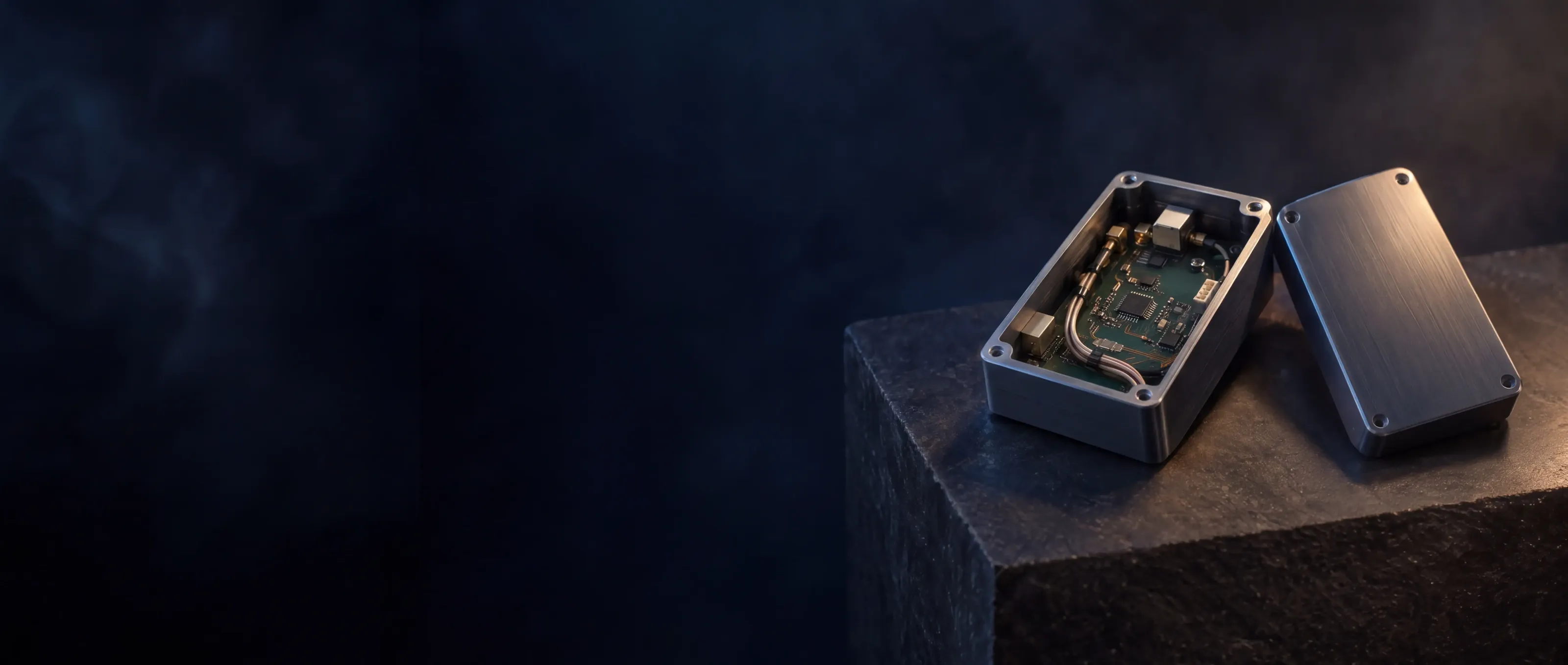
IP65 records that a sample passed a dust test and a water-jet test, and a NEMA Type is not its equivalent. What your cleaning regime does to the box is yours to specify.
Computing America Hardware. Custom hardware for physical automation and monitoring.
Describe the environment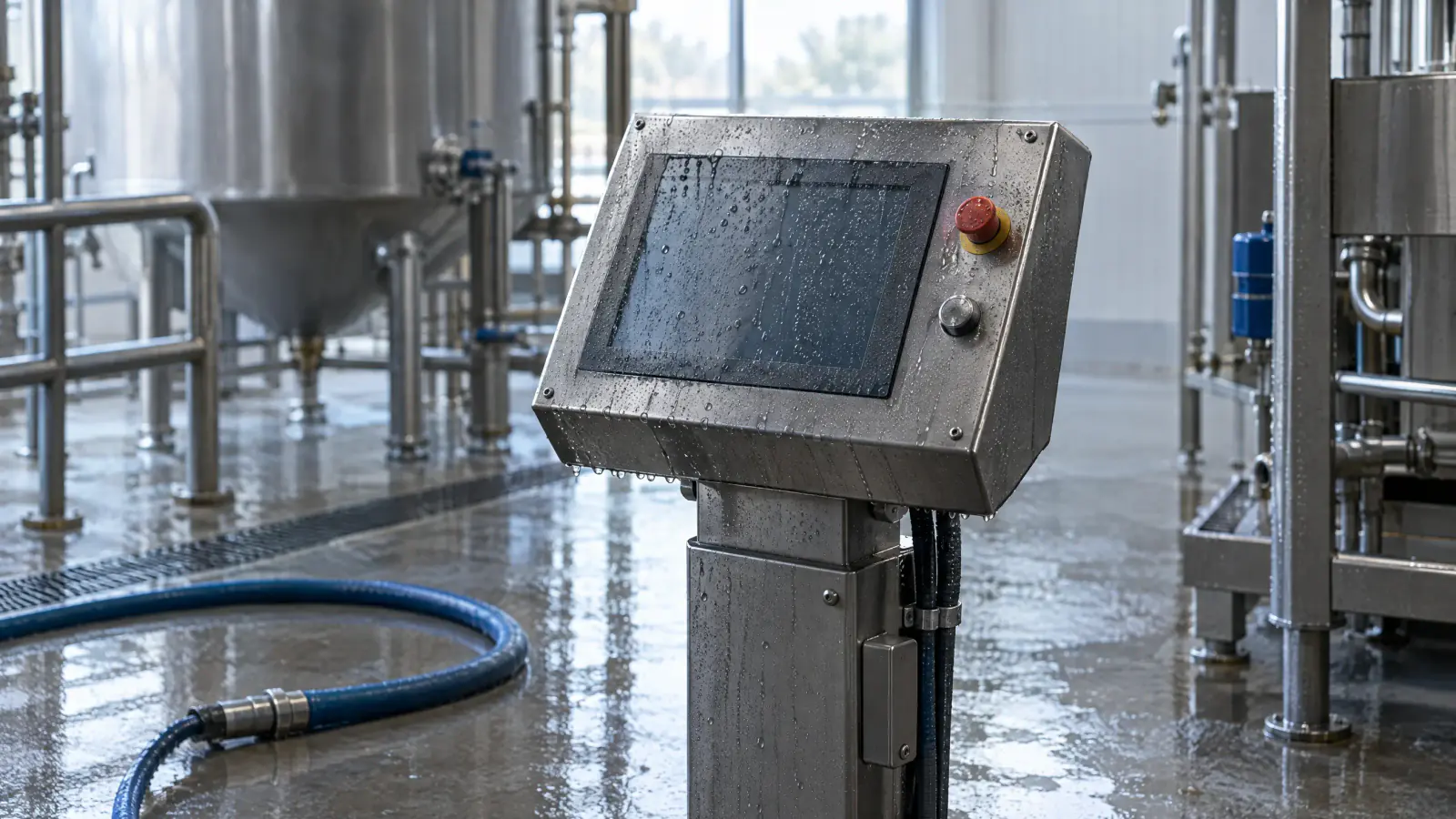
In short
- IP65 is two independent tests: the 6 is dust-tight, the 5 is water jets from any direction. The water digit is a ladder only up to 6, so IPX6 implies IPX5, but 7, 8 and 9 are separate tests.
- NEMA states that an IP degree rating can't be called equivalent to a NEMA Type, and that a NEMA Type meets or exceeds the corresponding IP degree. NEMA Types are tested fully installed and ready for use, while IP degrees may apply to partially completed states.
- IPX9 adds close-range, high-pressure, high-temperature jets to the water scale. Chemistry stays untested at any digit.
- A rating describes the sample that was tested, so whoever fits the cable entries decides whether the installed unit still matches it.
- Write the requirement from what the room does to the enclosure: cleaning chemistry, temperature, pressure, frequency and thermal cycle.
IP65 means a sample enclosure passed two separate tests. The 6 is the first digit, dust-tight: no ingress of dust. The 5 is the second digit, water: jets projected from any direction have no harmful effects. The code is IEC 60529 (opens in a new tab), in its consolidated second edition. On the dust scale, 5 is dust-protected, which lets a limited quantity of dust in, and 6 is the top.
The water scale is a ladder only up to 6. It runs 0 to 9, and IPX9 was added by Amendment 2. The standard says: "Up to and including second characteristic numeral 6, the designation implies compliance also with the requirements for all lower characteristic numerals." So IPX6 implies IPX5, but 7, 8 and 9 each stand alone. A device rated for powerful jets hasn't been shown to survive immersion, and an enclosure coded only 7, 8 or 9 is considered unsuitable for jets unless it is dual coded, such as IPX5/IPX7 or IPX6/IPX9.
IPX9
Close-range, high-pressure, high-temperature jets
Within: Stand alone: imply no lower test.IPX8
Continuous immersion
Within: Stand alone: imply no lower test.IPX7
Temporary immersion; implies no jet test
Within: Stand alone: imply no lower test.IPX6
Powerful jets
Within: Each implies every level below it.IPX5
Jets
Within: Each implies every level below it.IPX0 to IPX4
Within: Each implies every level below it.
Up to IPX6 each water level implies every level below it; IPX7, IPX8 and IPX9 imply none, so an IPX7-only box is unsuitable for jets unless dual coded.
SourceIEC 60529, second characteristic numerals 0 to 9; IPX9 was added by Amendment 2.
So the higher number can be the wrong specification for a washdown area. If the process involves a hose, name the jet test and pick it by flow: IEC 60529 tests IPX5 with a 6.3 mm nozzle at 12.5 L/min and IPX6 with a 12.5 mm nozzle at 100 L/min, both from 2.5 to 3 m. If cleaning uses hot water at high pressure from close range, add IPX9 as a dual code, such as IPX6/IPX9.
NEMA Types aren't IP equivalents, and the gap has a direction
North American estates mix the vocabularies, with an IP number on one quotation, a NEMA Type on the next, and a conversion chart in between. NEMA answers this in its own FAQ.
“It is not possible to state that an IP degree rating is equivalent to a NEMA Type designation. An IP degree rating only considers protection against ingress of solid foreign objects and ingress of water. The NEMA Types consider these protections but also consider other characteristics such as icing, and corrosion- and lubricant-resistance, and construction details.”
The same answer gives the direction: a NEMA Type meets or exceeds a corresponding IP degree. A conversion chart is safe read that way and misleading read the other, as when an IP-rated unit is swapped into a place where a Type was specified. In a US installation the NEC does not let an IP rating stand in for a Type: the FAQ cites NEC Section 110.28 for that.
NEMA adds a second distinction that matters on site. Its Types require enclosures that are fully installed and ready for use, while IP degrees may apply to partially completed states of installation.
What the IP code does not cover
Two things take a passing enclosure out of service, and neither is a digit:
- Washdown. A hot caustic or acidic solution applied under pressure attacks gaskets, membranes, screen bonding and any exposed metal that isn't the right alloy. What cleans the area, at what temperature and how often changes the gasket material, the bonding, the fastener alloy and often the mounting position.
- Entries. A cable gland fitted by whoever was on site, or an enclosure opened for service and closed again, is outside what the test sample proved. Nothing in the rating covers gasket aging either.
Write the requirement from the room
- 1.State the cleaning regime first: chemistry, temperature, pressure, frequency, and whether the enclosure is in the spray path or beside it.
- 2.State the thermal cycle: the range across a day, and whether the space is heated. That sets how much condensation to expect.
- 3.Name the ingress test itself. If the estate speaks in IP degrees, add the corrosion requirement separately, since the IP code doesn't carry it, for example NEMA Type 4X or a salt-spray test with the wetted material grade named.
- 4.Make the installation condition part of acceptance: entries fitted and sealed to at least the rating claimed. Check it on a real unit rather than assuming it from the certificate. Spray the closed, fully wired enclosure from all practicable directions with the jet test's nozzle and flow, for 1 minute per square meter of surface likely to be sprayed and at least 3 minutes. Then open the enclosure and look for water. This is a site check, not a certificate.
Sources
Next step
Tell us what cleans the area.
Name the chemistry, the temperature, and how often the area around the enclosure is washed down or wiped. We will tell you which part of the specification that changes, and what we would expect to fail first.
- Phone
- (214) 723-2510
- Reply
- A person replies, not a sequence: within one business day, from someone who would be on the engagement.
Packages
Start with a package
Four packages, each with its price on the page. Pick one and buy it online.
$199/month
Billed monthly
$182.42/month
Billed yearly
$499/month
Billed monthly
$457.42/month
Billed yearly
- Scammers stopped from sending email as you
- Your website and systems scanned every week
- Your email settings checked every week
- Everything in the 1 to 10 plan
- Covers up to 50 people
$199/month
after a one-time setup fee
- A site planned, designed and built for you
- Hosting and updates every month
$499/month
Billed monthly
$457.42/month
Billed yearly
$999/month
Billed monthly
$915.75/month
Billed yearly
- Your Google profile, fully set up
- A Google post every week
- 2 social posts a week
- Everything in Get found
- 4 social posts a week
- Your top 10 Google searches tracked
from$500/month
after a one-time setup fee
- Your data gathered from the tools you use
- A first analysis that answers your questions
- New findings every month
Related reading
 Engineering5 min read
Reference frames in sensor data: relative to what?
What to record beside every reading so two runs can still be compared a year later.
 Systems5 min read
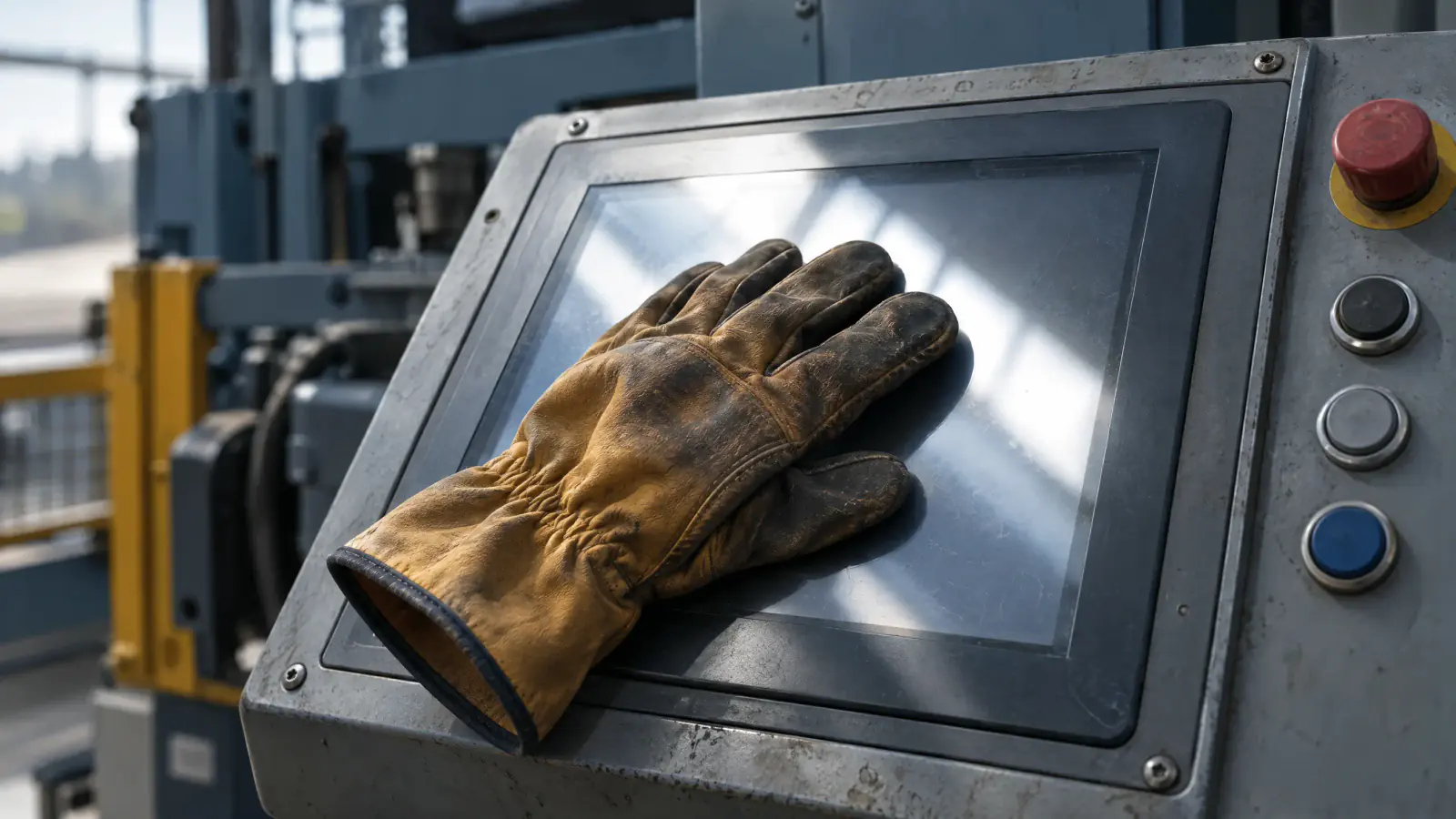
HMI design for gloves and glare: designed on a desk, used in a glove
Size targets for the glove, carry state by shape as well as color, and make every alarm actionable. Then take the screen to the machine and test it.
 Systems4 min read
Firmware updates for deployed units: the update path is the product
A unit that can't be updated safely has a fixed expiry date. The update path is settled early in the design and paid for over the fleet's whole life.