
Security
OT network segmentation: when the drawing and the switch disagree
The plant network diagram shows a segmented plant. The switch can show a permissive VLAN rule, a two-homed workstation, and a vendor's remote path that isn't on the drawing.
Computing America Cyber. Security assessments, penetration testing and staff training.
Send the drawing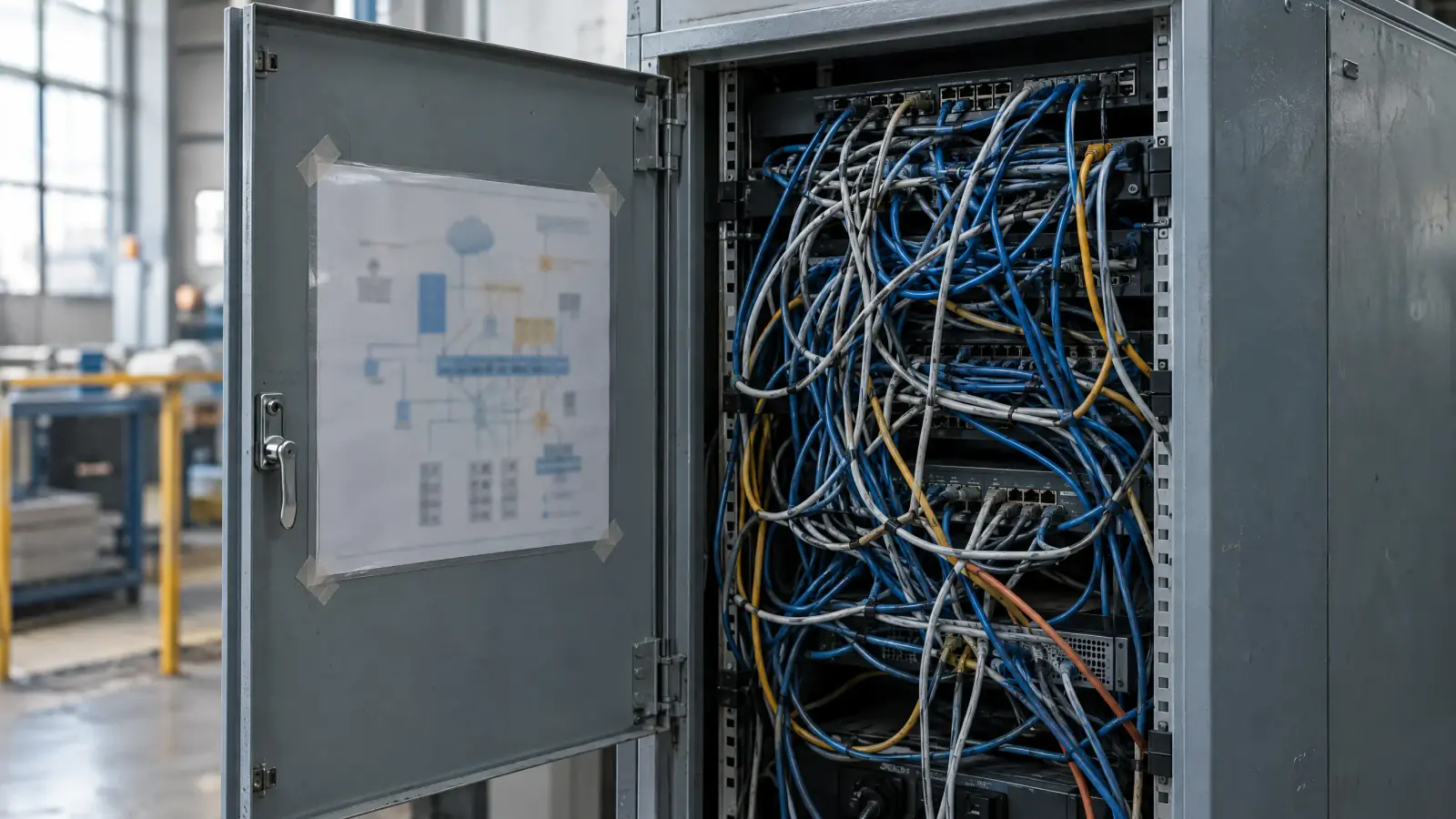
In short
- Every boundary on the drawing needs a named device and a rule you can read. If establishing what enforces it takes a week, that week is the finding.
- A VLAN is not a security boundary unless something enforces policy between VLANs. Two broadcast domains with an any/any route between them are one network drawn as two.
- A vendor's remote access can be missing from the drawing, and so can a two-homed machine. Compare the number of paths you list with the number a passive capture sees.
- Segment before you buy detection. A monitored flat network tells you an intrusion is spreading, and a segmented one limits how far it can spread.
- "Industrial protocols cannot be secured" is half wrong. Secure variants exist for several of them, and a device that predates them stays flat, so the control there is the network path it travels.
Is your plant network as segmented as its drawing says? The drawing records what somebody meant, and the switch records what happened. Plant networks get built a cell at a time, under time pressure, by parties who don't talk to each other, over longer than anyone's tenure.
That matters because everything downstream trusts the drawing: the risk assessment, the insurance questionnaire, the detection budget. If the boundary on it isn't enforced, each of them is aimed at the wrong thing.
Enterprise network
- To Firewall · drawn
- To Two-homed historian · not drawn
Firewall
On the drawing
- To Plant network · drawn
Two-homed historian
One adapter each side
- To Plant network
Vendor remote access
Added at commissioning
- To Plant network · not drawn
Plant network
VLANs joined by an any/any rule
The drawing shows one of three paths into the plant network; the vendor's, set up at commissioning, is the one IT may not know exists.
SourceIllustrative topology of the failures this article describes, not a measured plant.
The four places the drawing goes wrong
- The VLAN that isn't a boundary. Two VLANs are two broadcast domains, a much weaker claim than two networks. If a layer 3 device routes between them on an any/any rule, or on a subnet that has since grown, the plant is one network drawn as two. A diagram can't show this: it has boxes and lines, and no rules.
- The two-homed machine. An engineering workstation, historian, SCADA server or quality PC with an adapter on each side bridges the boundary the firewall enforces. There is often a reason, such as a reporting requirement that wasn't routed properly. The drawing shows it on one side, if at all.
- Remote access. An integrator or OEM set up a path in during a commissioning weekend, with that vendor's tool and credentials shared among its engineers. It often stays because removing it would mean the vendor can't help at two in the morning. IT may not know it exists.
- Time. The drawing was accurate the day the line was commissioned. Since then a cell was added, a vendor swapped a panel, a temporary trial link stayed, and a switch was replaced with whatever was in the van. Updating the PDF isn't anyone's job.
Why the IT playbook does not transfer
The instinct is to patch aggressively, put agents everywhere, enforce authentication and scan continuously. NIST's guide to operational technology security (opens in a new tab) explains why those controls need adapting on a plant floor. Three reasons matter here.
- Patching follows the OEM. Controller firmware is validated by the OEM against the machine, and an update outside that validation can void the OEM's support for the machine. Your window may be two shutdowns a year.
- Nothing installs. A twelve-year-old PLC has no agent and can't take one, and a hard active scan can crash it. Passive collection is the default for that reason.
- A login can be a hazard. On an HMI, a prompt between an operator and a stop command at 3am is a safety problem, and safety outranks security. That is one reason a shared HMI login can persist. A control that ignores the hazard tends to get defeated by people acting reasonably.
Some industrial protocols can be secured
A common line is that industrial protocols authenticate nothing, so whatever reaches the port can command the process. For several protocols the first half no longer holds, and that changes what you ask a vendor for. The IANA service name and port number registry (opens in a new tab) lists a secure-port row for several of them:
| Protocol | Standard port | IANA secure-port row |
|---|---|---|
| Modbus | 502 | mbap-s, port 802 |
| OPC UA | 4840 | opcua-tls, port 4843 (4840 can also run signed or encrypted) |
| DNP3 | 20000 | dnp-sec, port 19999 |
| S7comm (iso-tsap) | 102 | None |
| BACnet | 47808 | None |
Where a secure row exists, running the plaintext port may have been a choice, or the product may not implement the secure variant, since a registered port doesn't show that it does. Find out which, and whether the reason still holds. OPC UA sets its mode per connection: "None", "Sign" and "SignAndEncrypt" (opens in a new tab) are the three usable values, so port 4840 alone doesn't tell you which one you are running.
S7comm and BACnet have no IANA secure-port row, but secure variants exist. Siemens documents TLS-based PG/HMI communication (opens in a new tab) for the S7-1500 from TIA Portal V17, and BACnet/SC (opens in a new tab) (Addendum bj) carries BACnet over TLS and WebSockets. A controller on older firmware or a BACnet device that predates BACnet/SC has neither, and for that device the network path carrying it is what you constrain. "Our protocols cannot be secured" ends the conversation. "Which of these have a secure variant, which of our devices support it, and what compensates for the rest?" is a procurement question, and it belongs in writing to your integrator.
Fix it in this order
- 1.Measure. Build the inventory and the map of what talks to what by passive collection. Mirror a switch uplink to a SPAN (mirror) port or place a network TAP in front of the cell, then feed the capture to Zeek or Wireshark. No scan.
- 2.Segment before you buy detection, by zones and conduits. Group assets that share a function and a risk into zones, and treat each path between zones as a conduit: a named device with a rule you can read (IEC 62443-3-2 partitions a system this way (opens in a new tab)). A monitored flat network tells you at 3am that something is spreading. A segmented one limits how far it spreads and lets you deal with it Monday. Buy detection after that, because a segmented network with a known inventory has a definition of normal that a flat one lacks.
- 3.Treat remote access as its own project. A named account for each vendor engineer (a shared one doesn't count), access that is requested and expires, and a recording of what was done.
Take the drawing to the switch
Ask four things. If an answer takes a week to establish, that week is the finding.
- 1.Pick the most important boundary on it, the one between the plant and everything else, and ask what enforces it.
- 2.Read that device's configuration, whatever its label says.
- 3.Ask who can reach production from outside the building today, and count the vendors. Compare that count with the paths a passive capture sees.
- 4.Ask which protocols the capture shows on a plaintext port, and whether each has a secure variant your devices support.
Sources
- 1.SP 800-82 Rev. 3: Guide to Operational Technology (OT) Security (opens in a new tab), NIST
- 2.Service Name and Transport Protocol Port Number Registry (opens in a new tab), IANA
- 3.OPC 10000-4 UA Part 4: Services, 7.20 MessageSecurityMode (opens in a new tab), OPC Foundation
- 4.Configuration of TLS-based PG/HMI Communication and the Protection of Confidential PLC Configuration Data (TIA Portal V17) (opens in a new tab), Siemens
- 5.BACnet Secure Connect (opens in a new tab), BACnet International
Next step
Send us the network drawing.
We will tell you which boundaries on it are enforced by something and which are drawn, and what we would measure first to settle the ones we cannot tell from the diagram.
- Phone
- (214) 723-2510
- Reply
- A person replies, not a sequence: within one business day, from someone who would be on the engagement.
Packages
Start with a package
Four packages, each with its price on the page. Pick one and buy it online.
$199/month
Billed monthly
$182.42/month
Billed yearly
$499/month
Billed monthly
$457.42/month
Billed yearly
- Scammers stopped from sending email as you
- Your website and systems scanned every week
- Your email settings checked every week
- Everything in the 1 to 10 plan
- Covers up to 50 people
$199/month
after a one-time setup fee
- A site planned, designed and built for you
- Hosting and updates every month
$499/month
Billed monthly
$457.42/month
Billed yearly
$999/month
Billed monthly
$915.75/month
Billed yearly
- Your Google profile, fully set up
- A Google post every week
- 2 social posts a week
- Everything in Get found
- 4 social posts a week
- Your top 10 Google searches tracked
from$500/month
after a one-time setup fee
- Your data gathered from the tools you use
- A first analysis that answers your questions
- New findings every month
Related reading
 Security5 min read
OT network anomaly detection with fuzzy hashing (TLSH)
How a TLSH similarity hash over Modbus/TCP packet clusters flags drift, the alternatives that failed, and what the method misses.
 Systems4 min read
Modbus registers tell you where, not what: the data model at the edge
Modbus carries bits and 16-bit registers, and nothing about what they mean. Connecting a robot or monitor to a PLC means deciding where that meaning lives.
 Security3 min read
Penetration test vs vulnerability scan: what you are actually buying
Both are legitimate purchases. A sample report and a look for chaining show which one a quote is selling, and four questions test the vendor behind it.